
Design, History, Espresso Machine Brands & Compatibility
The E61 group head is one of the most recognizable and influential designs in espresso machine history. Originally introduced by Faema in 1961, the E61 group head changed the way espresso machines approached brewing temperature, water circulation, and mechanical extraction.
More than 60 years after its introduction, the E61 espresso machine group head remains widely used on home, prosumer, and commercial espresso machines. Its combination of substantial brass construction, thermosyphon circulation, mechanical pre-infusion, and proven mechanical components has made the design a long-standing favorite among espresso-machine manufacturers and enthusiasts.
The original E61 patent expired in 1996, allowing other manufacturers to adopt the underlying design and develop their own versions. As a result, there is now a large ecosystem of E61 espresso machines, E61-style group heads, and E61 replacement parts.
However, one important point should be understood: not every group head described as E61 uses exactly the same internal components or dimensions.
Understanding the differences is especially important when purchasing an E61 group gasket, shower screen, portafilter, valve, or other replacement part.
What Is an E61 Group Head?
An E61 group head is a mechanically operated espresso machine brewing group originally developed by Faema.
The traditional E61 group uses a large brass group head combined with a mechanical valve system and thermosyphon circulation. A lever on the side of the group operates internal cams, valves, and springs that control the flow of brewing water.
Unlike many modern espresso machines that use electronic controls or saturated group systems, the classic E61 relies heavily on mechanical operation.
The traditional design incorporates:
Large brass group-head construction
Thermosyphon water circulation
Mechanical brewing valves
Mechanical pre-infusion
Pressure-release functionality
Lever-operated brewing
Substantial thermal mass
These characteristics are responsible for much of the E61’s distinctive operating behavior.
E61 Group Head History
The E61 group head was introduced by Faema in 1961. It represented a major development in espresso-machine engineering at the time.
One of the design’s important innovations was the use of continuous heated-water circulation between the boiler and group head.
This thermosyphon system helped keep the group head heated and ready for brewing while the machine was operating.
The E61 also introduced a mechanical approach to pre-infusion and brewing control that became highly influential in later espresso-machine designs.
The design proved sufficiently successful that it became one of the most recognizable group-head architectures in espresso.
When Did the E61 Patent Expire?
The original E61 patent expired in 1996.
After the patent expired, other espresso-machine manufacturers could legally produce machines based on the underlying E61 design.
This helped create the enormous variety of E61-style espresso machines available today.
Manufacturers subsequently modified the original concept by adding technologies such as:
PID temperature controllers
Dual boilers
Rotary pumps
Vibration pumps
Flow-control valves
Pressure profiling
Digital temperature displays
Electronic controls
As a result, the modern E61 market includes both traditional machines and highly sophisticated prosumer espresso machines.
How Does an E61 Group Head Work?
A traditional E61 group head uses a combination of thermosyphon circulation and mechanical valve operation.
When the espresso machine is heated, water circulates between the boiler and group head. This continuous circulation helps maintain the temperature of the substantial brass group.
When the user raises the group lever, the internal mechanical system opens the appropriate valves and begins the brewing sequence.
The traditional sequence includes a period of mechanical pre-infusion before full brewing pressure is applied to the coffee.
When the lever is lowered, the group mechanism closes the water path and allows pressure in the brewing circuit to be released.
This mechanical sequence is one of the defining characteristics of a traditional E61.
Why Is the E61 Group Head Thermally Stable?
One of the main reasons the E61 design remains popular is its thermal mass and thermosyphon system.
The large brass group head retains heat, while heated water continuously circulates through the group.
This helps reduce temperature fluctuations during normal operation.
However, an E61 group head should not be considered a guarantee of perfect temperature stability. Actual performance depends on the complete espresso-machine design, including:
Boiler size
Boiler type
Thermosyphon configuration
Group-head construction
PID temperature control
Water flow
Machine insulation
Ambient temperature
Brewing frequency
Two espresso machines can therefore use E61 group heads while exhibiting different thermal behavior.
E61 vs. E61-Style Group Heads
The terms E61 group head and E61-style group head are sometimes used interchangeably, but there can be meaningful differences.
A traditional E61 generally follows the original mechanical architecture, including the characteristic lever-operated valve system and thermosyphon arrangement.
An E61-style group may retain the familiar external appearance while using modified internal components.
Manufacturers have developed proprietary variations to accommodate modern machine designs and features.
For consumers and parts suppliers, this distinction is important.
An E61-compatible gasket or shower screen should not be selected solely because the product description says “E61.” The exact dimensions and machine model should also be checked.
Which Espresso Machine Brands Use E61 Group Heads?
Many major Italian and international espresso-machine manufacturers have used E61 or E61-style group-head technology.
Faema
Faema is the original manufacturer associated with the E61 group head.
The company introduced the design in 1961 and continues to have a strong historical connection to E61 technology.
The Faema E61 Legend is an example of a machine that preserves the classic E61 heritage.
VBM (Vibiemme)
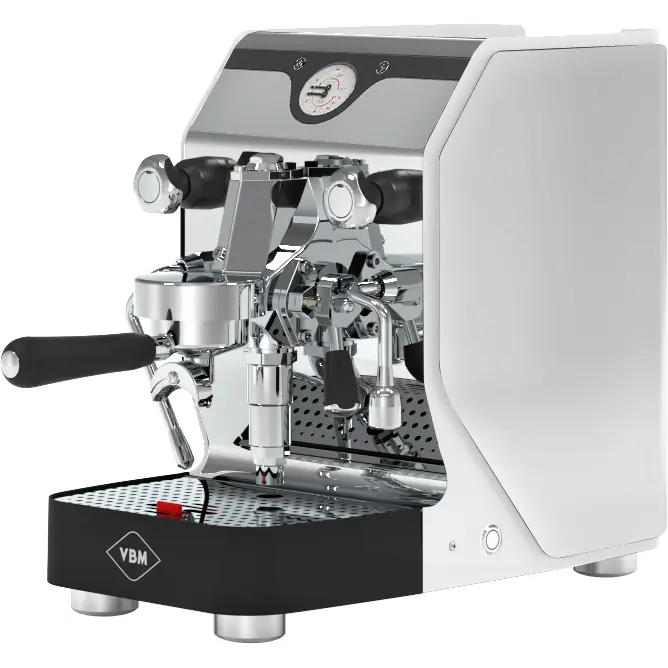
VBM, or Vibiemme, has deep historical connections to the E61 design.
The company became particularly well known for prosumer espresso machines such as the Domobar series.
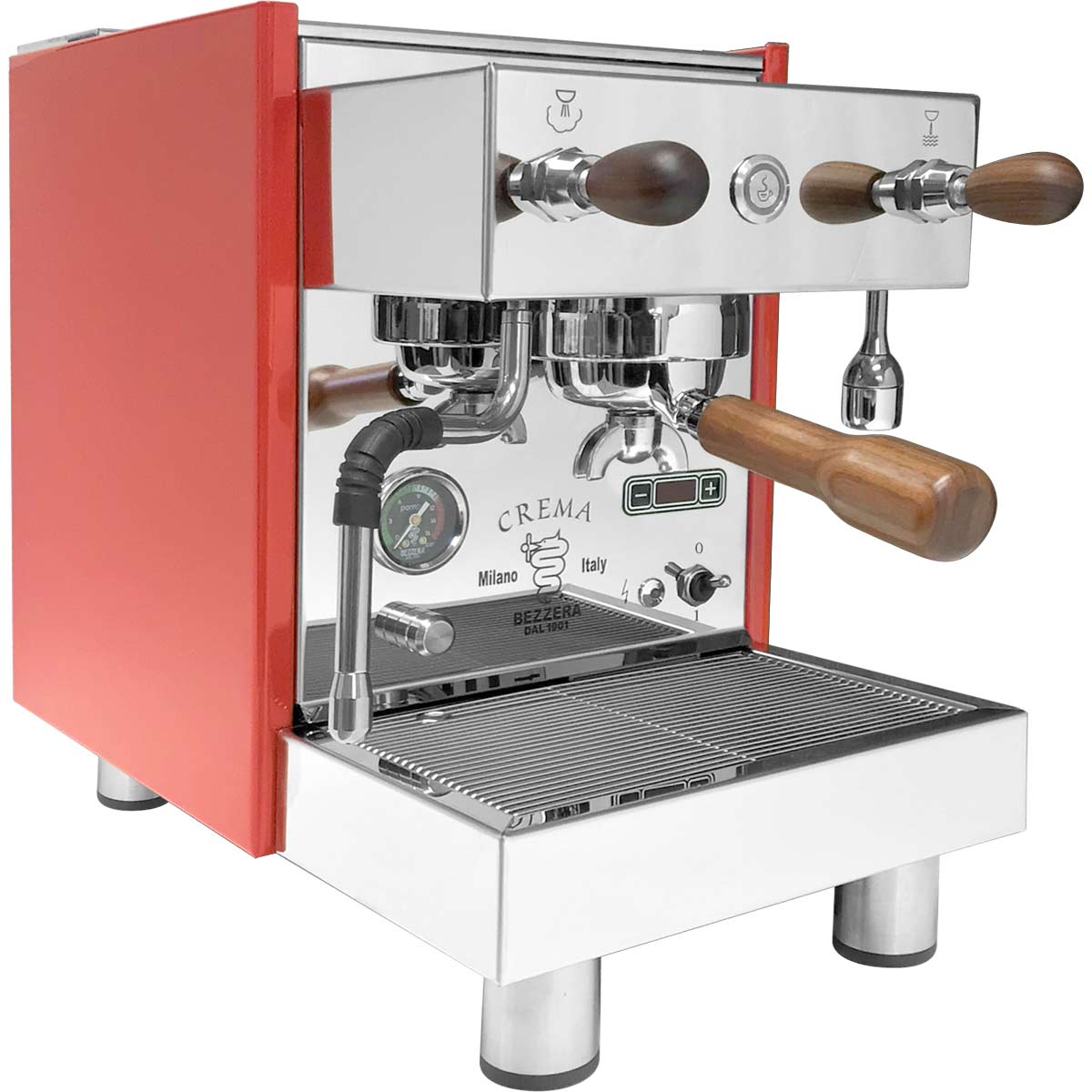
Bezzera
Bezzera is another historic Italian espresso-machine manufacturer associated with E61-style groups.
Models such as the Aria, Mitica, and DUO combine traditional group-head construction with modern espresso technology.
Rocket Espresso
Rocket Espresso is one of the most recognizable modern E61 espresso-machine manufacturers.
Its machines have included the Appartamento, Giotto, and R58 Cinquantotto.
Rocket combines the traditional E61 group-head appearance with modern prosumer machine features.
Profitec
Profitec offers numerous machines built around E61-style group technology.
Models such as the Pro 700, Pro 600, Pro 400, Drive, and RIDE demonstrate how the E61 design can be combined with modern temperature and flow-control technologies.
ECM
ECM Espresso Coffee Machines is well known for premium E61 prosumer machines.
Models such as the Synchronika II and Classika PID combine traditional E61 group technology with modern temperature control and premium stainless-steel construction.
Lelit
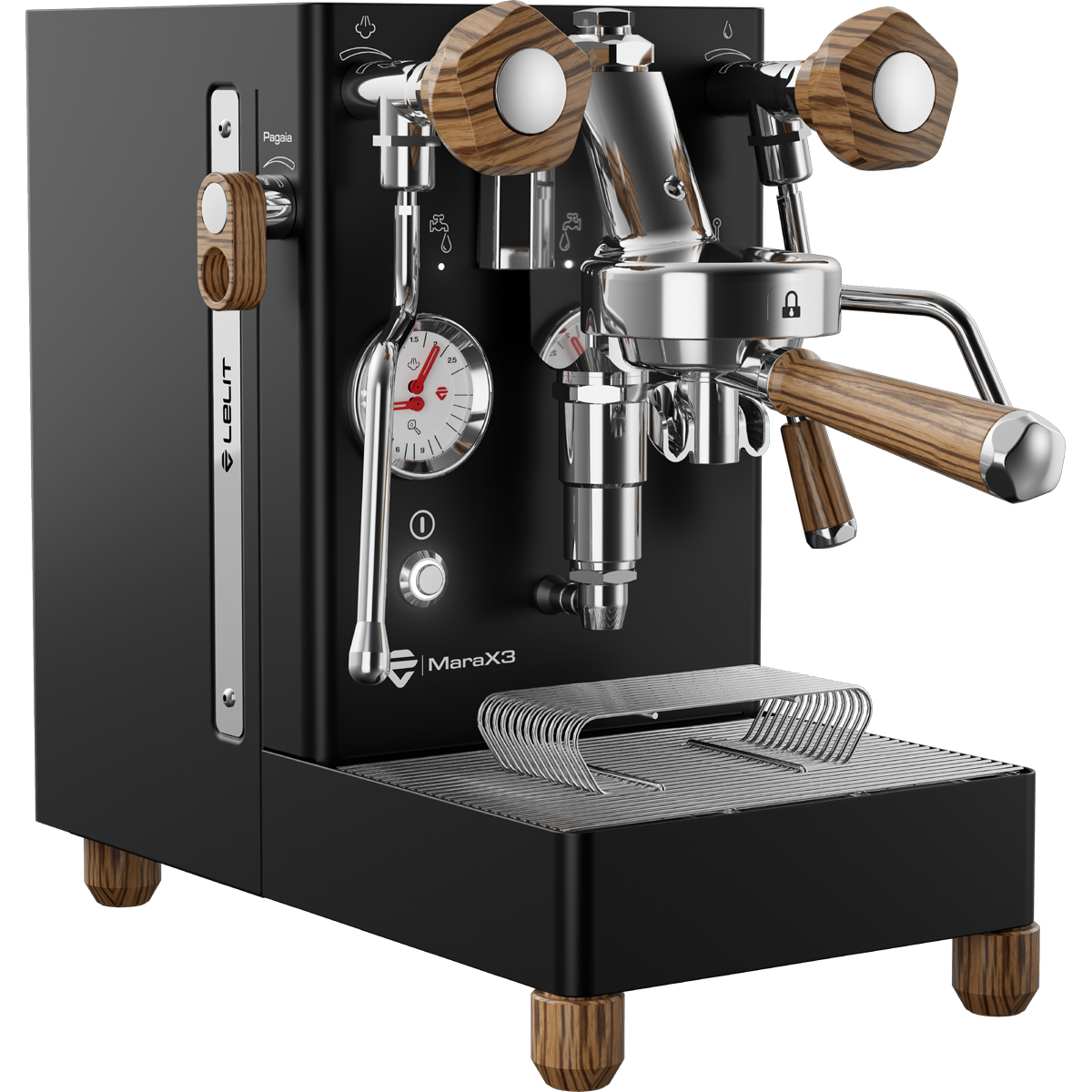
Lelit MaraX espresso machine in black with E61 group head
Lelit has incorporated E61 groups into several popular home espresso machines.
The Lelit Bianca is particularly notable for combining an E61 group with manual flow control.
The compact MaraX is another well-known E61-style machine.
Quick Mill
Quick Mill produces a number of machines using E61-style group technology, including models such as the Carola Evo, QM67, Aquila, and Anita.
Izzo
Izzo uses E61-style group technology on machines including the Vivi PID and Alex Duetto.
Isomac
Isomac has a long history of producing E61-style prosumer machines, including the Tea, Zaffiro, and Millennium.
Sanremo
Sanremo has used E61-style technology and proprietary variations on selected machines.
The company is known for combining traditional espresso engineering with modern machine design.
La Pavoni
While La Pavoni is particularly famous for its manual lever espresso machines, the company has also produced pump-driven machines using E61-style groups, including the Cellini Premium.
Expobar
Expobar became particularly popular among home espresso enthusiasts for machines such as the Brewtus, which brought E61-style group technology and dual-boiler configurations to a relatively accessible segment of the market.
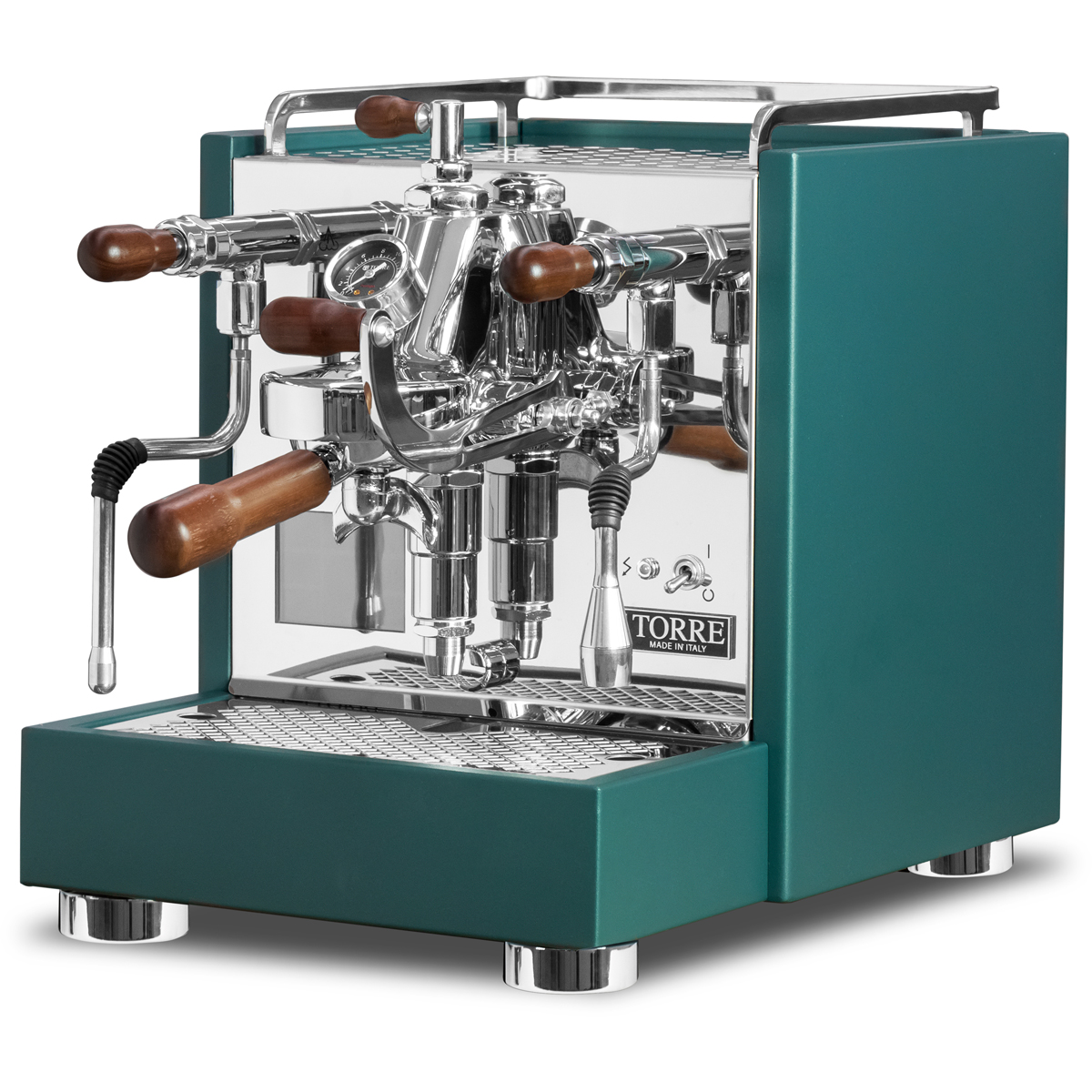
Torre
Torre is an Italian boutique manufacturer offering machines incorporating E61-style technology, including the Peppina Evo.
La Nuova Era
La Nuova Era produces machines such as the Cuadra and Altea, which incorporate robust commercial and prosumer group-head designs.
Wega and Promac
Wega and Promac are established Italian commercial espresso-machine manufacturers whose equipment demonstrates the broader use of traditional group-head engineering in professional café environments.
E61 Group Head Replacement Parts
Because E61 machines are produced by many manufacturers, there is a large aftermarket for E61 group head replacement parts.
Common E61 replacement components include:
E61 group head gaskets
Portafilter holder gaskets
E61 shower screens
Dispersion screens
Group valves
Valve springs
Cam assemblies
Lever components
Portafilters
Filter baskets
Group-head O-rings
Paper gasket shims
However, compatibility must always be verified.
E61 Group Head Gasket Compatibility
An E61 group head gasket is responsible for creating the seal between the portafilter and group head.
E61 gaskets are available in several thicknesses and dimensions. Common configurations include approximately 8 mm and 9 mm thick gaskets, although exact dimensions vary by manufacturer and machine.
The gasket’s:
Outside diameter
Inside diameter
Thickness
Profile
Material
Sealing surface
can all affect compatibility.
A gasket that fits one E61 machine may not necessarily be the correct gasket for another machine.
Why E61 Gasket Thickness Matters
The thickness of the group gasket determines the position of the portafilter when it locks into the group head.
As the original gasket wears, the portafilter may rotate farther into the group.
Replacing the gasket with the correct thickness can restore the proper portafilter locking position.
Some machines may also use a paper gasket shim or spacer to compensate for portafilter wear or adjust group-head sealing depth.
For this reason, replacement gaskets should be selected using the machine model, original part number, or exact gasket dimensions whenever possible.
E61 Shower Screens
The E61 shower screen distributes brewing water across the coffee puck.
Although many E61 machines share similar shower screens, mounting methods and dimensions can vary.
When replacing an E61 shower screen, check:
Screen diameter
Center hole
Mounting method
Thickness
Group-head model
Original part number
A product described simply as an “E61 shower screen” should therefore be verified against the specific espresso machine.
E61 vs. Saturated Group Head
Stainless steel espresso machine with wooden handles and dual spouts
The E61 is often compared with the saturated group head, but the two designs use fundamentally different approaches.
A traditional E61 group uses thermosyphon circulation and mechanical components to maintain temperature and control brewing.
A saturated group is designed as part of the boiler or water-heating system, with the group exposed to heated water from the boiler to help maintain a stable brewing temperature.
Saturated groups are particularly common on commercial espresso machines.
The important point is that a 58 mm portafilter does not automatically mean an espresso machine uses an E61 group head.
Brands such as La Marzocco, Nuova Simonelli, and Rancilio commonly use 58 mm portafilters or related accessories, but their signature machines generally employ saturated or proprietary group architectures rather than a traditional E61 thermosyphon mechanism.
Why Are E61 Espresso Machines Still Popular?
The E61 design has remained popular for several reasons.
Proven Engineering
The basic architecture has been refined and used for decades.
Thermal Mass
The substantial group-head construction helps retain heat.
Thermosyphon Circulation
Continuous water circulation helps maintain the group at brewing temperature.
Mechanical Pre-Infusion
The traditional mechanism provides mechanical pre-infusion before full brewing pressure is reached.
Serviceability
The mechanical design is well understood by espresso-machine technicians, and many replacement components are readily available.
Modern Adaptability
Manufacturers can combine E61 groups with modern technologies such as PID controllers, dual boilers, rotary pumps, and manual flow control.
Are All E61 Group Heads the Same?
No.
This is one of the most important things to understand about E61 espresso machines.
Although many machines share the E61 architecture, manufacturers have introduced differences in:
Internal valve designs
Thermosyphon passages
Group dimensions
Gasket dimensions
Gasket thickness
Shower-screen mounting
Portafilter locking geometry
Flow-control systems
Pre-infusion systems
Internal components
Therefore, an E61 replacement part should be matched to the specific espresso machine model and group-head configuration whenever possible.
E61 Group Head FAQ
What does E61 mean on an espresso machine?
E61 refers to a famous espresso-machine group-head design originally introduced by Faema in 1961. The traditional design uses a large brass group, thermosyphon circulation, and mechanical valve operation.
Who invented the E61 group head?
The E61 group head was developed and introduced by Faema in 1961. Faema is historically recognized as the original manufacturer and patent holder of the E61 design.
When did the E61 patent expire?
The original E61 patent expired in 1996, allowing other manufacturers to use the underlying design and develop their own E61-style group heads.
Why is the E61 group head so popular?
The E61 remains popular because of its thermal mass, thermosyphon circulation, mechanical pre-infusion, proven design, serviceability, and ability to work with modern espresso technologies.
Is an E61 group head better than a saturated group?
Neither design is universally better. E61 and saturated groups use different approaches to temperature management and brewing. Machine design, temperature control, boiler configuration, and intended use are more important than the group-head name alone.
Do all E61 espresso machines use the same gasket?
No. E61 machines can use different gasket dimensions and thicknesses. Even machines with similar-looking groups may require different gaskets.
What size is an E61 group head gasket?
There is no single universal E61 gasket size. Many traditional E61 machines use gaskets around 8 or 9 mm thick, but inside and outside diameters can vary. Always verify the dimensions and machine compatibility before purchasing a replacement.
Does an E61 espresso machine use a 58 mm portafilter?
Many E61 machines use a 58 mm portafilter, but portafilter diameter alone does not determine whether a machine has an E61 group head.
Are E61 group heads interchangeable?
Not necessarily. While many E61 components share common dimensions, manufacturers can use different internal mechanisms, gasket profiles, shower screens, valves, and portafilter interfaces.
Which espresso machine brands use E61 group heads?
Brands associated with E61 or E61-style group technology include Faema, VBM, Bezzera, Rocket Espresso, Profitec, ECM, Lelit, Quick Mill, Izzo, Isomac, Sanremo, La Pavoni, Expobar, Torre, La Nuova Era, Wega, and Promac, among others.
Does an E61 group head require maintenance?
Yes. Like any mechanical espresso-machine group, an E61 should be periodically inspected and maintained. Common service items include the group gasket, shower screen, valves, springs, cam components, and lubrication of appropriate mechanical parts.
How long does an E61 group gasket last?
Gasket life depends on machine usage, temperature, cleaning practices, coffee oils, and installation. Regularly inspecting the gasket for hardening, cracking, leakage, or excessive portafilter rotation is a good way to determine when replacement is needed.
Final Thoughts: The E61 Group Head Legacy
The E61 group head remains one of the most influential designs in espresso-machine history.
Introduced by Faema in 1961, the design combined thermal mass, thermosyphon circulation, mechanical pre-infusion, and a durable mechanical brewing system. Following the expiration of the original patent in 1996, numerous manufacturers adopted the architecture and developed their own versions.
Today, the E61 can be found on everything from traditional Italian espresso machines to advanced dual-boiler prosumer machines with PID temperature control and manual flow profiling.
For espresso enthusiasts, the E61 offers a combination of heritage, mechanical engineering, thermal stability, and modern adaptability.
For espresso-machine parts suppliers and technicians, however, the most important lesson is that E61 does not necessarily mean universal compatibility. Group gaskets, shower screens, portafilters, valves, and other components should be selected according to the exact machine and group-head specifications.
Understanding the differences between traditional E61 groups, E61-style groups, and other group-head technologies makes it easier to choose the correct espresso machine—and the correct replacement parts for keeping it operating properly.